CYP Newsletter Issue #1
Read all about the latest from our Children & Young People newsletter and download in a range of accessible versions.
Continue Reading
What’s it really like to visit the UK Parliament when you have sight loss? In this blog, Muhammed (Communications Officer) shares his experience of travelling to Westminster, attending Prime Minister’s Questions, and exploring one of the UK’s most historic buildings. From accessibility highlights to unexpected moments along the way, this personal account offers an honest and engaging insight — with an image gallery included to bring the visit to life.
Written by Muhammed Ravat
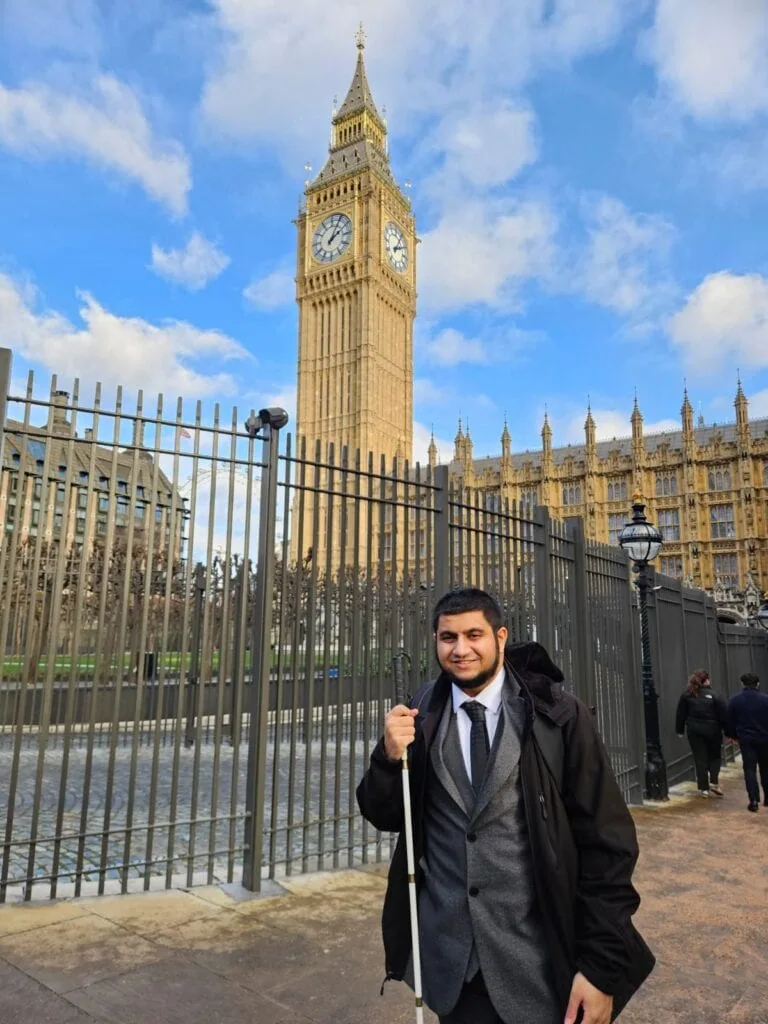
For many people, the UK Parliament is a place experienced through voices on the radio, clips on the television, or headlines in the news. It is rarely thought of as a physical space that can be visited, walked through, and explored. When you live with sight loss, historic buildings can sometimes feel distant or inaccessible, both practically and emotionally. That is why being invited to the Houses of Parliament was such a meaningful opportunity. On Wednesday 7 January 2026, I had the privilege of visiting Parliament following an invitation from Sureena Brackenridge MP, the Member of Parliament for Wolverhampton North East, and the day turned out to be not only fascinating but also eye-opening in terms of accessibility and inclusion.
Muhammed was invited to visit Parliament after MP Sureena Brackenridge was inspired by his personal story and his journey through the Get Set Progress Internship, delivered by Thomas Pocklington Trust in partnership with Beacon. From starting out as a communications intern to now working full-time as Beacon’s Communications Officer, his progress is a real example of what’s possible with the right support and determination. He had the opportunity to explore the historic building and watch Prime Minister’s Questions live, making it a truly memorable day.
The day began early with travel from our local station to Birmingham New Street. Passenger Assistance staff were waiting to meet me as I stepped off the train, guiding me safely through the busy station to the Assisted Travel Lounge. The echoing announcements, rolling suitcases, and constant movement of people made it clear just how busy the station was. Unfortunately, on the way, someone in a rush kicked my cane out of the way. While it lasted only a moment, it served as a reminder of how vulnerable we can feel when people are not fully aware of their surroundings.
From Birmingham, we continued on to London Euston. Once there, we took a taxi to the Houses of Parliament, which made the journey far easier than navigating steps and escalators underground. On arrival, we went through airport-style security checks before being welcomed by Sureena Brackenridge.
Our visit began with a short walk into Westminster Hall. The space immediately felt vast and open, with high stone walls that carried sound and gave a sense of age and importance. Standing in the exact place where Queen Elizabeth II lay in state after her passing was deeply moving. It was surreal to know I was in the same hall where historic moments had unfolded over hundreds of years, including speeches by influential figures such as Nelson Mandela.
From there, we moved into the Central Lobby, a busy crossroads within Parliament where footsteps echoed and voices blended into a steady hum. I was surprised to learn that there is even a working post office within the building. After collecting our tickets, we made our way by lift to the public gallery, handing over bags and phones and passing through another quick security check.
We were seated at the very top of the public gallery, behind a row of wooden desks fitted with an old-fashioned radio speaker. In front of us were thick stone pillars and an open view across the chamber below. We arrived early, which allowed us to listen to debates on issues affecting Northern Ireland before Prime Minister’s Questions began at midday.
Prime Minister’s Questions was far more engaging than I expected. Hearing the voices of MPs rise and fall, the laughter, interruptions, and quick exchanges between parties made the session feel lively and intense. The Speaker of the House’s firm voice brought order to the chamber, and it was fascinating to hear the formal language used, such as MPs referring to one another as “my honourable friend”. The rivalry between parties was clear, but so was the tradition and structure that keeps the debate moving.
After Prime Minister’s Questions, we met Ameerpret, the MP’s assistant, and Pete from the Information and Tours team, who gave us a detailed and engaging private tour. Pete’s descriptions brought the building to life as he explained its history and architecture, including the Victorian design and the rebuilding that took place after the great fire. He also explained that the building was once a royal palace and home to King Henry VII.
We heard about famous trials that took place within these walls, including those of King Charles I — the only monarch ever to be executed — and Guy Fawkes. Pete also spoke about more recent history, including visits from modern world leaders such as the Prime Minister of Ukraine.
One particularly encouraging moment came when Pete shared that he himself has a disability. He is an amputee below his right elbow, something I hadn’t noticed until the conversation turned to disability and employment. He explained that many people with disabilities work throughout Parliament. This was reassuring and inspiring to hear, showing that inclusion is not just discussed in Parliament but actively practised. He also mentioned a former Paralympian who now contributes to the House of Lords from her wheelchair.
Parliament is a complex building with many steps, changes in level, and narrow corridors, which did present some challenges. However, the accessible toilet facilities were genuinely impressive. As I entered the cubicle, a voice-guided system activated and provided a clear spoken description of the room. It explained where everything was located, how to lock the door, and where to find the sink, soap dispenser and hand dryer. This allowed me to use the facilities independently and with confidence, without needing assistance.
Before leaving, we visited the gift shop, where the familiar smell of new stationery mixed with the sounds of browsing visitors. Alongside the usual pens, pencils and magnets were more unusual items, including a “Future PM” baby grow, Honourable Gentleman cufflinks, branded bath salts and even jars of chilli chutney.
The return journey added one final twist to the day. As we entered Euston Station, the sound of a large crowd gathered together immediately caught my attention. The departure boards showed that all trains were cancelled and platforms closed, with no clear information available.
Around 15 minutes later, an announcement explained that there had been trespassing on the tracks just outside the station and that services would resume shortly. The quiet stillness as people listened quickly turned into rushing footsteps and raised voices as platforms reopened. During the scramble, someone chose to step over my cane rather than allow me through — surprisingly managing to keep their balance.
We chose to travel to and from Parliament by taxi rather than using the Tube. The number of steps down to the platforms, combined with lifts that did not go all the way, would have made underground travel more difficult, especially with time constraints.
This visit to the UK Parliament was far more than a tour of a historic building. It was an immersive experience that brought democracy, history and accessibility together in a very real way. From standing in Westminster Hall to listening to Prime Minister’s Questions live, the day offered moments of reflection, learning and inspiration.
For anyone with sight loss, experiences like this show that even the most historic and complex places can become accessible with the right support and thoughtful design. An image gallery and video from the visit are included alongside this blog to help bring the experience to life and offer additional context for readers.
I hope this account encourages others to feel more confident about visiting places that may seem intimidating at first. With the right planning, support and awareness, these spaces truly can be for everyone.
Read all about the latest from our Children & Young People newsletter and download in a range of accessible versions.
Continue Reading
Join us this July for a range of friendly and accessible community activities. Whether you’d like to try something new, get out and about, or simply enjoy some good company, […]
Continue Reading
Read all about the latest from our Lifestyle newsletter and download in a range of accessible versions.
Continue Reading
Read all about the latest from our Lifestyle newsletter and download in a range of accessible versions.
Continue Reading
Join us this June for a range of friendly and accessible community activities. Whether you’d like to try something new, get out and about, or simply enjoy some good company, […]
Continue Reading
Read all about the latest from our Lifestyle newsletter as well as what’s on this month . Join us this May for a range of friendly and accessible community activities. […]
Continue Reading